Surface engineering plays a critical role in controlling interfacial transport during phase-change processes. By tailoring surface properties, such as roughness, wettability, and porosity, engineered surfaces can enhance phase-change performance at the interface. Structured or patterned surfaces enable precise manipulation of liquid–vapor interactions, promoting more efficient heat and mass transfer. These innovations are key to improving thermal performance in energy, water, and electronics cooling systems.
Boiling:
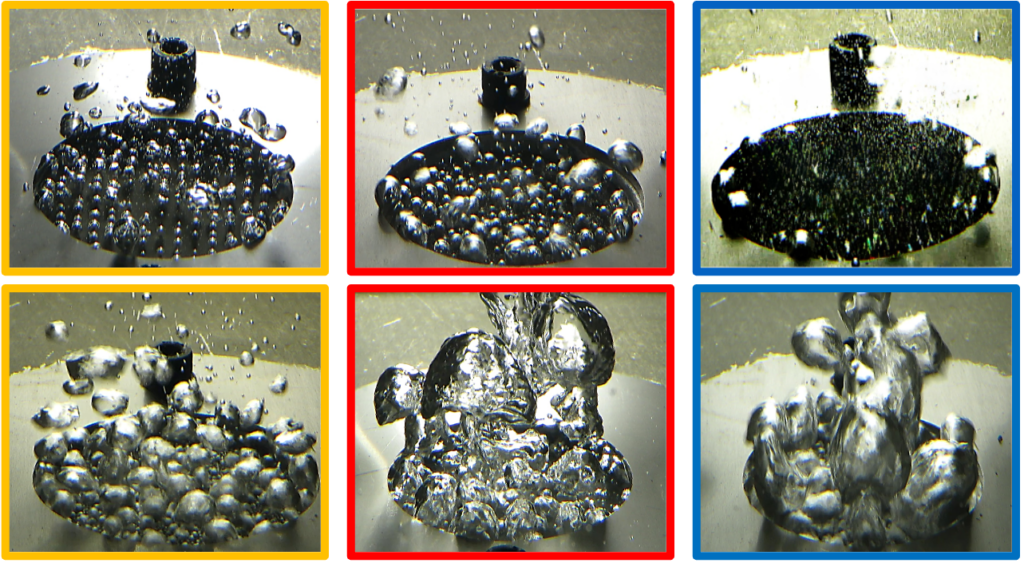
Boiling is one of the most effective modes of heat transfer, driven by the rapid phase change from liquid to vapor at a heated surface. At the heart of this process lies interfacial transport—where heat, mass, and momentum exchange at the liquid–vapor interface critically influence performance. The dynamics of bubble nucleation, growth, and departure are governed by complex microscale phenomena, including microlayer evaporation, contact line motion, transient conduction, and localized pressure variations. Recent research has focused on engineering structured and functionalized surfaces to manipulate these interfacial interactions. Micro- and nano-textured surfaces, porous coatings, and wettability gradients have demonstrated the ability to increase nucleation site density, reduce bubble departure diameter, and delay the onset of dry-out. Such enhancements contribute to significantly improved heat transfer coefficients and increased critical heat flux—both essential for high-performance thermal management systems.
Understanding and controlling these processes enables the design of next-generation boiling surfaces, with applications ranging from electronics cooling and power generation to advanced water purification technologies.
Condensation:
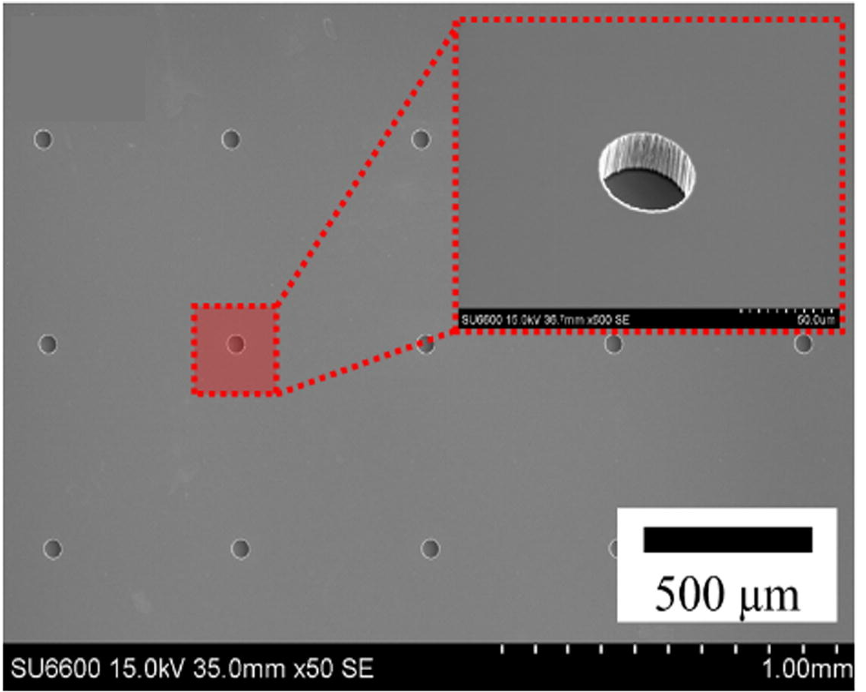
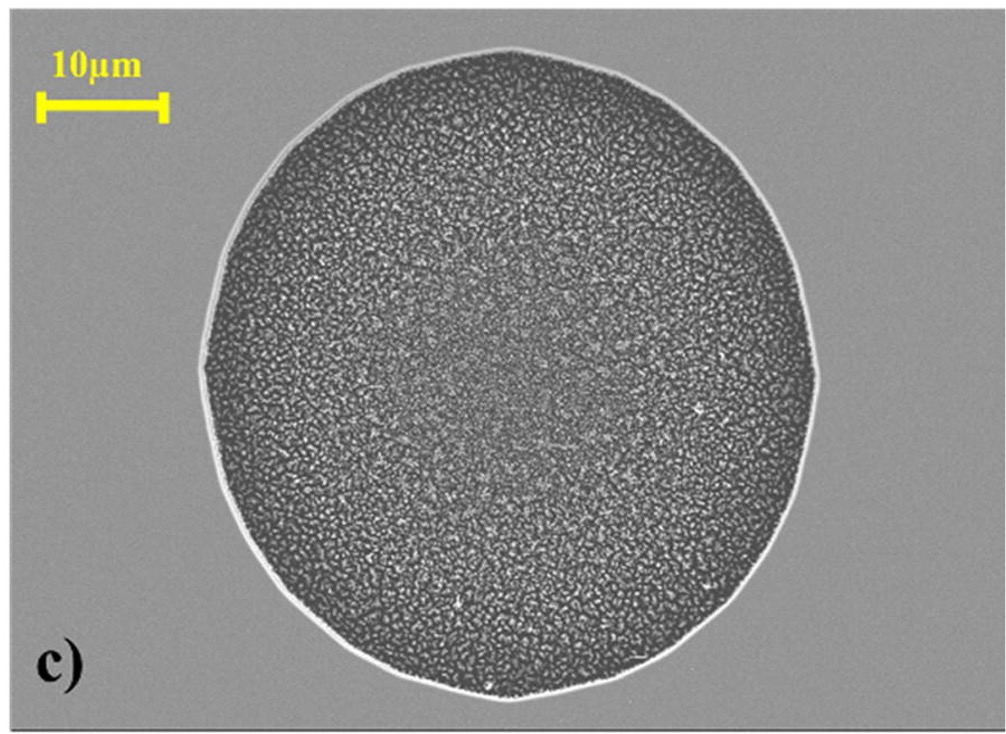
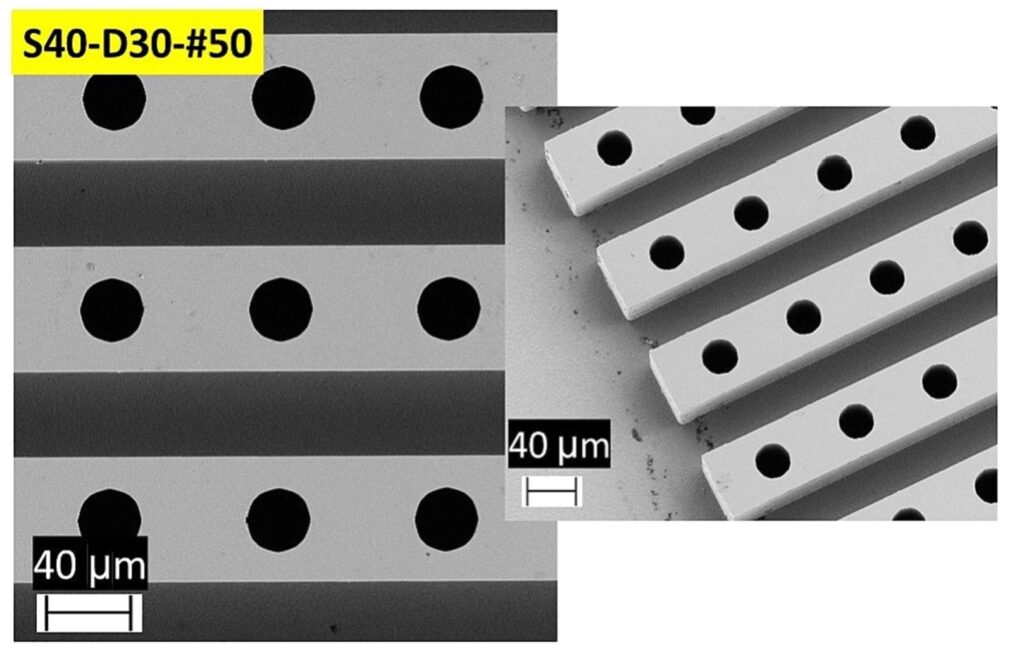
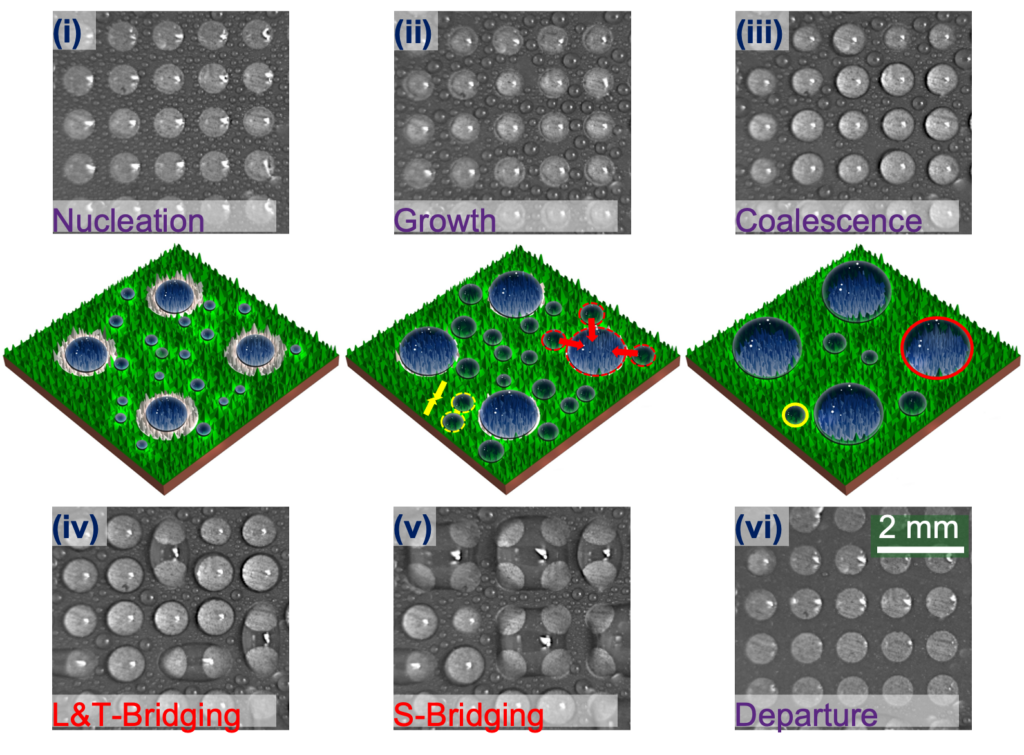
Condensation is a fundamental phase change process in which vapor transforms into liquid upon contacting a cooler surface, releasing latent heat. This process is widely used in energy systems, water harvesting, and thermal management. The efficiency of condensation is highly dependent on the surface condition and the mode of condensation—either filmwise or dropwise. Dropwise condensation, in particular, offers significantly higher heat transfer performance due to reduced thermal resistance at the interface. At the core of efficient condensation lies the ability to promote droplet nucleation, growth, coalescence, and removal. Recent research has focused on engineering surfaces with controlled wettability and micro/nano-scale features to sustain dropwise behavior. Biphilic and slippery liquid-infused porous surfaces (SLIPS) have emerged as promising platforms for enhancing droplet mobility and reducing retention time. These innovations lead to increased condensation rates and improved thermal performance.
Advancing the understanding and control of interfacial phenomena during condensation is critical for developing high-efficiency heat exchangers, water recovery devices, and energy systems operating under humid or high-heat flux conditions.
Evaporation:
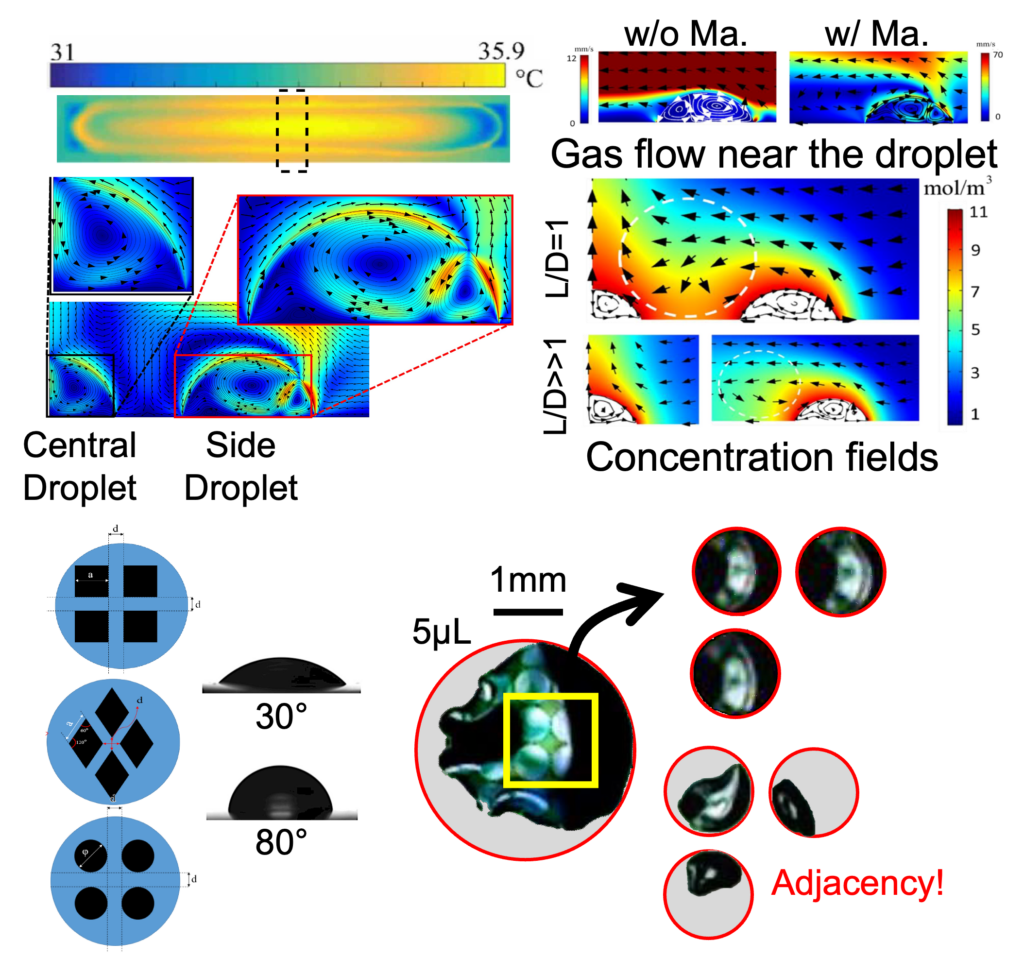
Evaporation involves the transition of a liquid into vapor at the interface, driven by thermal energy input and governed by interfacial mass, heat, and momentum transfer. As a surface-dominated process, evaporation is particularly sensitive to interface properties, such as wettability, roughness, and thermal conductivity. Understanding the mechanisms of thin film evaporation, contact line dynamics, and Marangoni flow is essential for optimizing evaporation in various thermal and environmental systems. Recent research emphasizes the role of engineered surfaces in modulating interfacial phenomena to enhance evaporation rates. Micro/nano-textured surfaces, chemical patterning, and responsive materials have been developed to control local heat distribution and fluid motion, increasing efficiency in processes ranging from cooling and drying to water purification.
Controlling interfacial behavior and enhancing evaporation performance are key to advancing next-generation thermal systems that are compact, energy-efficient, and environmentally sustainable.
Solar Driven Interfacial Evaporation:
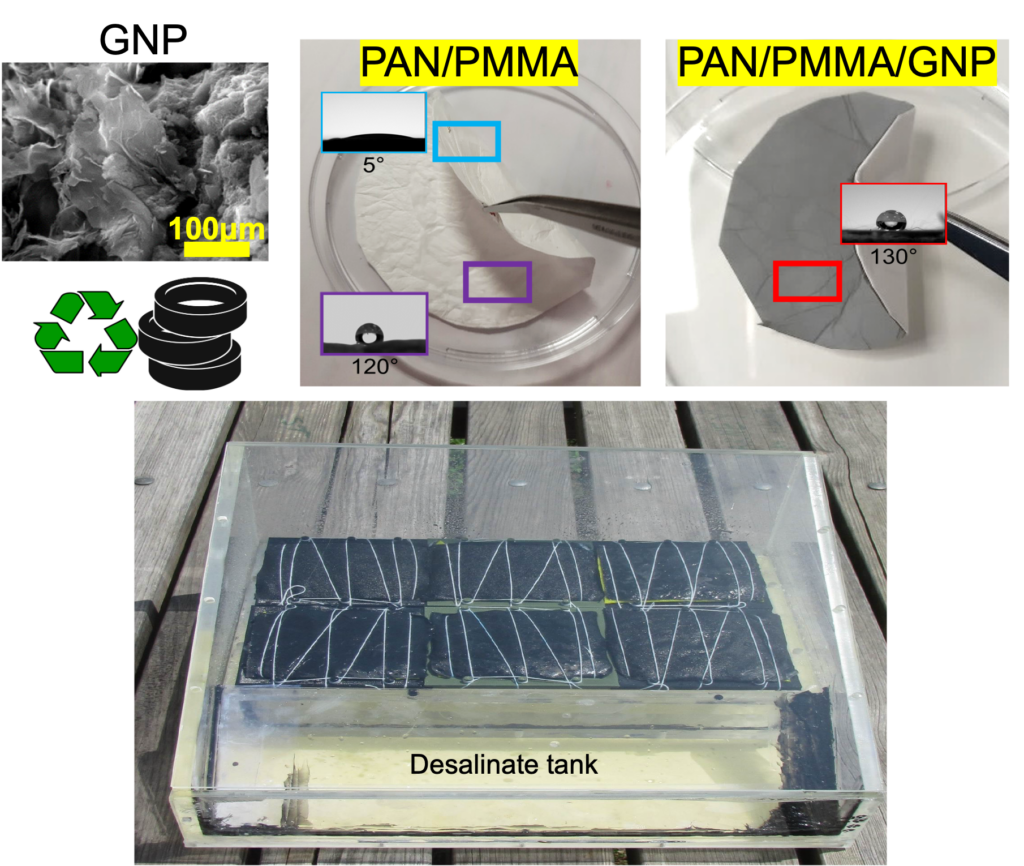
Solar-driven interfacial evaporation (SDIE) is an emerging approach for sustainable water purification and desalination, leveraging localized solar heating at the water–air interface to maximize evaporation efficiency. By minimizing heat losses to the bulk liquid and concentrating energy at the evaporating surface, SDIE enables high water production rates using minimal energy input. This process is enabled by photothermal materials and 3D-engineered structures that absorb sunlight and convert it into localized heat. Advanced surfaces—often fabricated from carbon-based materials, metal-organic frameworks, or biomimetic coatings—are designed to enhance light absorption, manage thermal gradients, and regulate water transport. Innovations in wettability control, porous architecture, and multistage heat recovery have further increased SDIE efficiency and scalability.
Ongoing research is focused on optimizing interfacial transport, improving material stability, and integrating sustainable or upcycled materials. These advancements are critical to deploying SDIE technologies for off-grid water access, environmental remediation, and climate-resilient infrastructure.